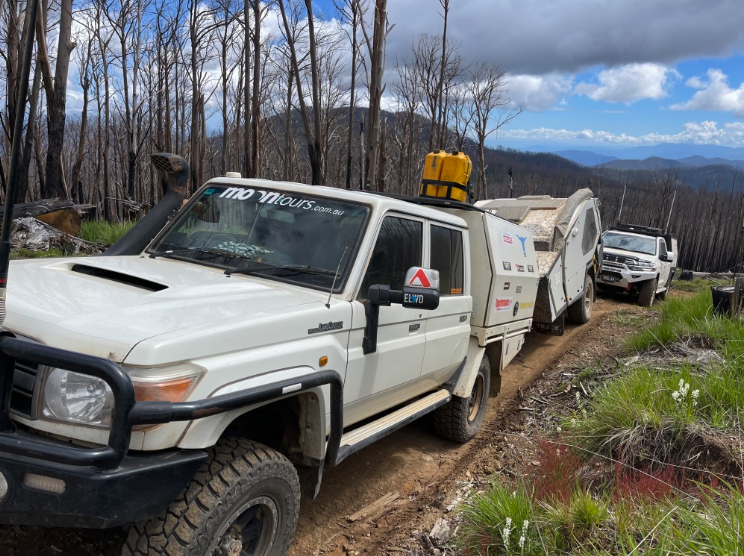
The Victorian High Country is one of our most underrated 4WD touring destinations in Australia. With thousands of kilometres of tracks, incredible free camping, splendid views and low on crowds (unless it’s a long weekend) it is one of our favourite destinations to visit.
Your meeting point, unless otherwise advised, will be at the Mt Mittamatite Carvan Park in Corryong where Moon Tours will have booked you a powered site for day one of the itinerary, check in from 2pm. The tour ends when roll into Mansfield by lunch on the last day.
FRIDGE SPACE (catered tours only)
Please keep half a fridge available for your chef and catered meals.
DIETARY REQUIREMENTS (catered tours only)
Please reply to chef Jarrod included in this email and myself with your dietary requirements, allergies and foods you really dislike. FYI good chefs don’t do low fat and we always serve too much.
A lot of the meals are already gluten free but not all. If gluten-free is requested as a genuine medical reason, ie celiac disease, we can cater for you. If it is a lifestyle choice and you occasionally eat it we’d prefer you did not request a special menu for yourself.
PERMITS / VEHICLE REG
Moon Tours will arrange all your permits for the trip and any bookings required. We will need your vehicle, trailer make, model and registration number.
PRE-TRIP VEHICLE AND TRAILER PREPARATION
All our tours require a reasonably well set up and very well maintained vehicle and trailer due to the nature of our tours. After market suspension (Land Rover Disco / new defender excluded), good tyres, UHF radio with external aerial (no hand held radios without external aerial please) as a start for the Vic High Country tours.
Please book your vehicle and trailer in for a pre trip service and inspection with a 4WD and camper trailer specialist. Among other things the following jumps to mind from experience.
– Suspension and tyres: There are very few exceptions to this rule. Inneos, Land Rover it. Anything else and it is mandatory we upgrade our suspension and tyres. You do not need a crazy lift, a slight legal lift and heavier duty suspension for the job of touring and towing is perfect. All-Terrain tyres in good condition. Please don’t drag out the half worn out set that have been sitting in the shed for years. Use them for around town and put a decent set on with two spares on rims. If your trailer has different wheels and tyres you will need at least one spare for the van.
– Wheel bearings: Please have them inspected, serviced, adjusted, repacked and or replaced accordingly. When they wheels literally fall off a vehicle or trailer it is a real problem.
– Brakes: Vehicle brakes, brake controllers, trailer brakes and hand brakes. This is so important, unlike most other 4WD destinations in Australia here we are going to be contending with gravity. Please make a point of getting your brakes serviced before this trip.
– 12V wiring and charging: The most common faults we have on tour are related to 12V wiring. Everything from trailers not charging, brake controllers not working, fridges not working, trailer and anderson plug wiring too tight and being pulled out, wires run under vehicles exposed and rubbing, solar not charging. You name it, we see it. Please have your 4WD and trailer specialist inspect all your wiring and fuses prior to the trip.
INSURANCE – VEHICLE / TRAILER, ROADSIDE, RECOVERY, PERSONAL TRAVEL INSURANCE
Ok, yep, these are all different things. You are not covered by Moon Tours at all on a tag-along for any of these.
– Domestic travel insurance: You should protect your holiday investment like you would any overseas holiday with domestic travel insurance in the event you need to cancel due to unforeseen circumstances. It happens quite a lot. If you were going overseas I am sure you would invest in travel insurance. This is no difference. As outlined in our terms and conditions, website and invoices as a business we need to stick to our terms and conditions. Deposits are non-refundable with terms of balance payments in our Ts & C’s. A quick google search and you will find plenty of options for domestic travel insurance, we can’t advise you.
– Roadside assist: We recommend everyone take out roadside assistance top cover. In Victoria we have RACV total care, it’s less than a few hundred a year, covers me for any vehicle I drive and has saved many a headache every year for clients on tour. This may not help you if you’re broken down proper off-road but in general, if we can get you to a main road by towing you out you will be covered from there.
– Remote recovery. This is somewhat new and as far as we know is only available with Club 4×4 vehicle insurance which we have. You can choose up to $30,000 of remote recovery coverage with your insurance. It has nothing to do with roadside assistance, rather it is like an amount allowed to recover a vehicle from anywhere by any means (not really, you need to read up on the terms).
– Accident insurance: It goes without saying your vehicle and trailer should be well-insured for accidents. Here’s something interesting though, let’s say you’re in the bush and you hit a rock, log, hole or water (you need to check what your insurance covers you for) that damages your vehicle or you run into a tree for example and you can’t drive it. This wouldn’t be covered by roadside assistance but the towing and recovery may be covered by insurance as an accident as opposed to a breakdown. We’ve seen this applied from the middle of the Simpson Desert.
ESSENTIAL SPARES AND TOOLS
– Belts, hoses, tensioner pulleys, wheel studs, brake pads / shoes, wheel bearings (especially for the trailer), it is pretty rare for vehicle bearings to go if they’re well maintained but I still carry them and recommend you carry a spare set when touring.
– Filters; Oil, fuel, air, cabin, snorkel. We run snorkel socks although they’re not everyone’s cup of tea we have never had an issue and they work well in convoy, the key is cleaning them regularly.
– Fluids; engine oil, trans oil, diff oil, brake fluid.
– 12V spares; electrical tape, anderson plugs, fuses, relays, globes, multi-meter, test light, wire, joiners if you don’t know how to solder.
– Additives / lubricants; Radiator stop leak, fuel treatment, Bug Off, Liquid metal, silicone, sikaflex, WD40/CRC, degreaser, contact cleaner, brake cleaner, grease, filter cleaner and filter oil if you are using a filter sock or reusable air filter.
– Tie downs, cable ties, cloth tape, mix of screws, nuts and bolts.
– Tools; Basic tool kit, socket set, drill, drill bits, impact gun, grinder (grinding, cutting, wire discs)
– Tyre repair; Air compressor, tyre plug repair kit and tyre slime, a decent jack and base you can lift the car and camper with.
– Engine scan tool / gauge; Everyone should Invest in a gauge ie UltraGauge that read and clear engine codes. These are handy because they also display things like transmission temps on LC200’s which are an issue as well as a myriad or additional gauges your dash won’t show you. Gauges don’t however offer the best description, cause, potential issue and fix of the fault code. For this you need a scan tool. Basic tools from someone like Autophix for a couple of hundred will do this for you.
You will probably use this more than any other tool these days. Importantly you can clear engine codes and take vehicles out of limp mode and it may help you find and fix issues with your vehicle.
– Workshop manual; This is a must for touring.
FIRE
It is essential you carry at least two fire extinguishers in working order and a fire blanket. ARB fire sticks are also a good idea. Be sure to check your fire extinguishers, we have found that old units may not work when you want them to. Generally, if you can hear and feel the powder moving around when you shake it they should work. The power settles so extinguishers should be shaken up regularly. Tapping the cylinder with a rubber mallet can help shake up the powder.
We’ve also found that the small ones do not go far when you need them.
FUEL, WATER, RECOVERY
Fuel: You may need a couple of jerry-cans depending on your set up with up to 500km between fuel stops towing off road and on dirt.
Water: Plenty of freshwater around and it is a relatively short trip so I do not expect anyone to have any issues with water. Try to keep the water tanks to what you think you need, not what you can carry to keep the weight down where we can.
Recovery gear: Please carry a basic recovery kit for this trip. At a minimum a kinetic rop (snatch strap), a couple of soft shackles, a couple of maxtrax and a shovel.
SUPPLIES, REFUELLING, WATER, DUMP POINTS
During the tour, you will have the opportunity to get basic supplies, fuel, water and groceries. A couple of days in we go through the town of Omeo where we will stop for fuel and a pie, there’s an IGA and hardware store here. After Omea we will not see another town until we end in Mansfield.
Dump points. You might find dump points in Omeo if you have a look online.
AMENITIES, THE BUSH TOILET AND TOILET PAPER
Do not leave toilet paper buried or otherwise in the bush, animals will dig it up and it floats around the bush for months, longer in dry areas. There’s not much worse than rolling into a beautiful camp to find toilet paper everywhere.
1/ dig a hole for your business
2/ burn paper in the hole
3/ fill the hole in with dirt once the paper is burnt
If you chose not to burn your paper in the hole you can bag it and burn it on the fire at the end of the night.
Drop toilets available at Tom Groggin, Wonnangatta and Lovicks hut with drop toilets. We do pass a couple, public toilets in Omeo and Mt Hotham on day three, drop toilet at Dogs Grave on the same.
We’re really looking forward to meeting you all and showing off the high country.